Commitment of TGI to Dignified, Equitable, and Sustainable Labor Practices
At Transportadora de Gas Internacional S.A. E.S.P. (hereinafter TGI), we recognize that people are the fundamental pillar of our sustainability and competitiveness. Therefore, we promote a work culture focused on respect, well-being, and equity. We go beyond compliance with current labor regulations, working proactively to consolidate safe, fair, and inclusive work environments.
At TGI, we offer competitive and equitable remuneration, which not only complies with the law but also exceeds the cost of living, guaranteeing equal pay without gender bias. Additionally, we ensure the well-being of our employees by responsibly managing work hours, limiting overtime to exceptional situations, and actively promoting the enjoyment of paid annual vacations.
This commitment reinforces our vision of sustainability and generates a positive impact on our work teams, also strengthening the relationship with the communities where we operate. To complement these efforts, we have extended social protection coverage beyond legal requirements, offering additional benefits for the comprehensive well-being of our workers. Through constant and constructive dialogue with workers' representatives, we address key issues proactively, and in situations that compromise job stability, we commit to following consultation and notice periods to ensure respectful and transparent treatment. This commitment extends to our own operations, employees, contractors, and, progressively, to our supply chain, in articulation with the guidelines of Grupo Energía Bogotá (GEB).
Labor Practices Management Programs
We have structured, measurable, and documented programs that allow us to fulfill and strengthen our labor commitments. These programs include:
1. Dignified Salary and Equitable Compensation
We ensure that our workers receive fair, equitable, adequate, and above-the-cost-of-living remuneration. This is materialized through:
· An internal minimum wage higher than the legal minimum, agreed upon in the Collective Bargaining Agreement.
· A salary structure based on technical job valuation and market studies, avoiding gender biases in role valuation.
· Annual salary review considering economic variables, performance, and collective agreements.
· A total compensation policy that includes extra-legal benefits, insurance, bonuses, and well-being programs.
2. Responsible Management of Work Time
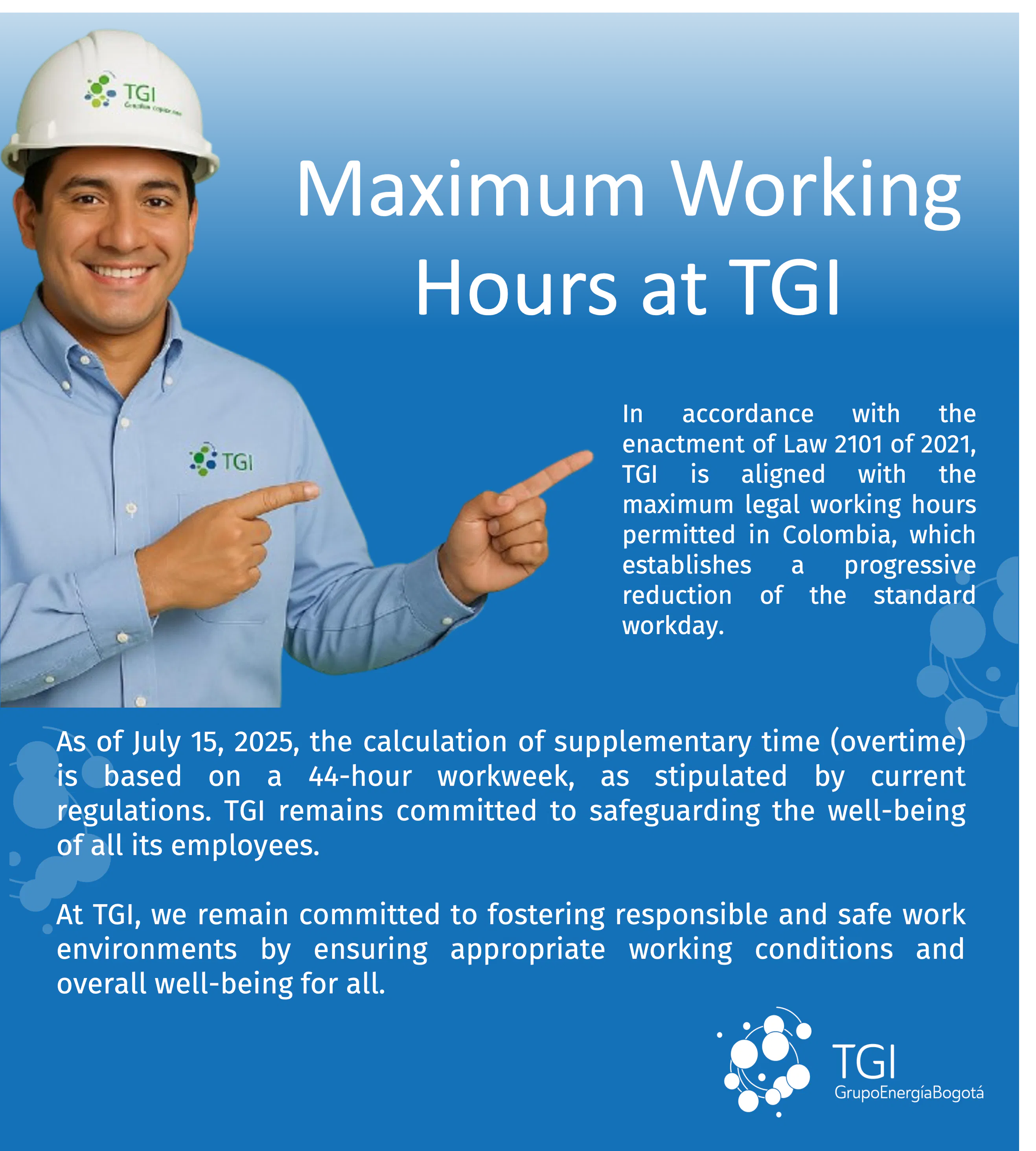
Using technological tools, we monitor work hours and the use of overtime in real-time. Our actions include:
· Digital registration of entries, exits, and breaks.· Supervision of compliance with the legal maximum working day.
· Rigorous control and prior authorization of overtime, with recognition and payment according to the law.
· Promotion of the use of rest time as part of our well-being strategy.
3. Well-being and Complementary Social Protection
We offer corporate health coverage for all our workers, regardless of their position or contract type. This benefit includes:
· Expanded access to medical and hospital services.
· Mental health and preventive medicine care.
· Services that complement those of the public health system.
4. Equal Remuneration and Gender Equity
Salary equity is a central principle in our talent management. Our actions include:
· Salary structures designed with objective methodologies.
· Monitoring of gender pay gaps.
· Non-discrimination policy in selection, promotion, and compensation.
· Training for leaders on unconscious biases.
· Follow-up indicators for equity and diversity.
5. Effective Use of Annual Vacations
We guarantee the enjoyment of paid vacations for all workers, for which we have implemented in our talent management practices:
· Scheduling and follow-up systems.
· Automatic alerts to avoid the accumulation of vacation periods.
· Internal policies that promote effective rest.
· Payment in accordance with the law, without affecting the worker's income.
6. Social Dialogue and Labor Representation
· We promote labor relations based on respect, transparency, and the participation of workers and their representatives. This includes:
· Permanent dialogue tables with union representation.
· Participation in joint committees.
· Follow-up to the Collective Bargaining Agreement.
- Prior consultation before organizational decisions with a labor impact.
7. Professional Development and Adaptation to Change
Our "Open Doors" strategy promotes an inclusive and bias-free culture. Its actions include:
· Inclusive selection processes.
· Diversity training and participation in external spaces.
· IDE criteria integrated into the relationship with suppliers and human resources management processes.
· Organizational awareness about equity, inclusive leadership, and collective prosperity.
8. Inclusion, Diversity, and Equity (IDE)
Our "Open Doors" strategy promotes an inclusive and bias-free culture. Its actions include:
• Inclusive selection processes.
• Diversity training and participation in external forums.
• Integrated DEI criteria in supplier relationships and human resources processes.
• Organizational awareness about equity, inclusive leadership, and collective prosperity.
Publication and Transparency
Our commitment to dignified, equitable, and sustainable labor practices is supported by publicly accessible institutional documents that allow our actions in this area to be verified. The main available resources include:
INTERNAL WORK REGULATIONS TGI.pdf

At TGI S.A. ESP, we believe that the sustainable development of the energy sector must go hand in hand with generating opportunities in the regions where we operate. For this reason, we promote the hiring of both skilled and unskilled labor from local communities, as well as the prioritization of goods and services sourced from these areas. This vision is formalized in our HSE Manual for Contractors, which forms an integral part of our suppliers’ contractual obligations.
In 2022, within the framework of our Open Doors Strategy, we strengthened this manual to help close gender gaps in an industry that has historically been male-dominated. Since then, we established that at least 30% of the positions offered by our contractors in local territories must be filled by women, and that goods and services led primarily by women will be given priority, provided they meet the required technical and quality standards.
Our progress demonstrates this commitment:
- In 2024, we generated 1,858 jobs in local operations, of which 15% were filled by women.
- The proportion of local population working at our sites reached 99.76%, while direct positions at TGI were held by 98.11% local employees.
- We have set a 2025 goal to increase women’s participation in our operations, which we report annually in our sustainability report and within our indicator system.
Additionally, to further expand local employment opportunities, in 2025 we designed a training program in coordination with the Cesar Compensation Fund – CONFACESAR, aimed at 200 young people from Curumaní, Codazzi, La Paz, and Chiriguaná. The program seeks to prepare them for employment opportunities at TGI and in companies within the sector, and includes job placement advisory services to support their entry into the labor market.
Hiring rate by age, gender, job category, nationality, and ethnicity – 2024 | Men | Women |
Under 30 years old | 28.57% | 20% |
Between 31 and 50 years old | 71.43% | 80% |
Over 51 years old | 0 | 0 |
Senior Management | 4.76% | 0 |
Middle Management | 0 | 10% |
Adviso | 4.7% | 0 |
Professional | 57.14% | 70% |
Support/Assistance | 33.33% | 20% |
Nationality (Colombian) | 100% | 100% |